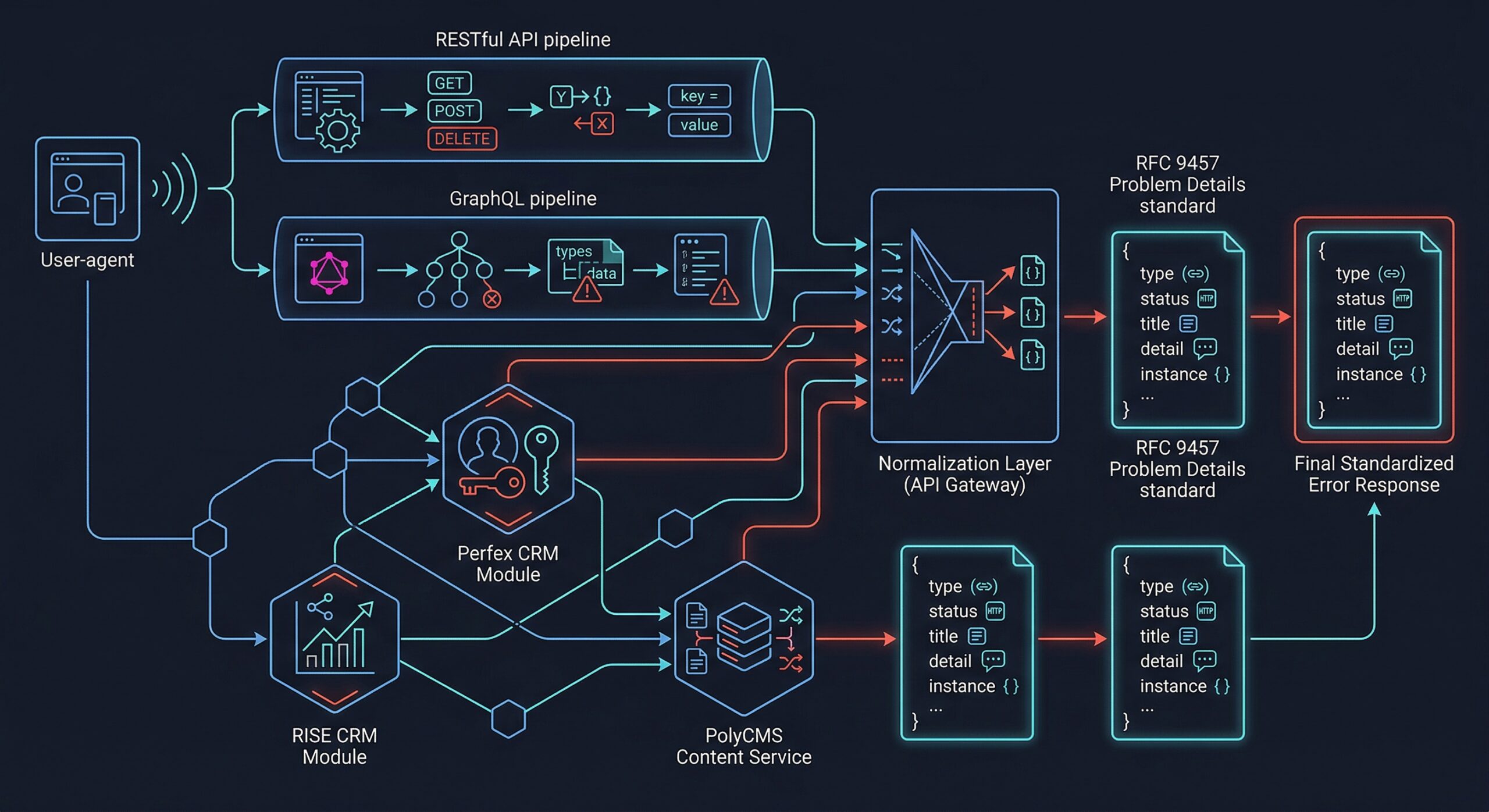
RESTful API and GraphQL Developer Documentation
RFC 9457 — Problem Details for HTTP APIs defines a standardized error response structure for modern HTTP API platforms. The specification obsoletes RFC 7807 and establishes a consistent error contract across HTTP-based RESTful APIs and API gateway transport layers.
This documentation describes practical implementation strategies of RFC 9457 in production-grade HTTP API infrastructure, including microservices, SaaS platforms, CRM ecosystems, and CMS-driven automation systems.
Why RFC 9457 matters in modern API architecture
Distributed systems require predictable error semantics. Without a standardized error contract:
- client error parsing becomes brittle
- monitoring pipelines lose semantic consistency
- API governance becomes fragmented
- frontend-backend coupling increases
- debugging production incidents becomes slower
RFC 9457 introduces a structured, machine-readable error representation suitable for:
- RESTful API platforms
- HTTP transport layers used by GraphQL gateways
- microservices orchestration environments
- API-first SaaS architecture
- enterprise integration environments
Adoption helps reduce long-term technical debt in error handling strategy.
RFC 9457 Core Schema
The standard defines a JSON object with predefined semantic fields:
- type
URI identifying the problem category. Should reference stable documentation. - title
Short human-readable summary. - status
HTTP status code associated with the problem. - detail
Diagnostic explanation specific to this occurrence. - instance
URI reference identifying the specific occurrence of the problem. - extension members
Optional metadata for domain logic, tracing, validation context, or operational diagnostics.
Example:
{
  "type": "https://api.example.com/errors/invalid-query",
  "title": "Invalid Query Parameter",
  "status": 400,
  "detail": "Parameter 'limit' must be positive integer",
  "instance": "/users?limit=-1"
}
RESTful API Error Contract Design
RFC 9457 enables strict and consistent error contract definition across HTTP API surfaces.
Recommended design pattern:
- map domain exceptions to stable RFC problem type URIs
- expose a consistent error type URI namespace
- enforce response consistency via middleware
- normalize upstream service errors at API gateways or platform boundaries
- propagate correlation identifiers via extension members
Typical RESTful API implementation flow:
- request validation
- domain service execution
- exception interception
- problem details serialization
- observability event emission
Benefits:
- predictable client SDK behavior
- simplified API documentation
- unified API lifecycle governance
- reduced integration friction
GraphQL Error Normalization Strategy
GraphQL defines its own application-level error format. RFC 9457 does not replace that model, but it can be used to standardize HTTP transport-level failure semantics when GraphQL is delivered over HTTP.
Recommended integration layers:
- API gateway
- federation router
- HTTP transport middleware
- hybrid REST-GraphQL edge layer
GraphQL error wrapping pattern:
{
  "errors": [
    {
      "message": "Validation error",
      "extensions": {
        "problem": {
          "type": "https://api.example.com/errors/graphql-validation",
          "title": "GraphQL Validation Failed",
          "status": 400,
          "detail": "Field 'email' required"
        }
      }
    }
  ]
}
A unified transport-level strategy supports:
- consistent monitoring across protocols
- centralized error analytics
- simplified frontend error handling logic
- cross-service governance enforcement
Microservices and API Gateway Integration
RFC 9457 adoption is typically implemented at platform boundary layers.
Key integration points:
- gateway response normalization
- service mesh error mapping
- distributed tracing metadata injection via extension members
- policy-driven error categorization
- rate limiting and security failure reporting
In multi-tenant SaaS environments, a standardized error model enables:
- tenant-aware error routing
- SLA monitoring automation
- compliance-grade audit logging
Observability and Debugging
Extension members may include:
- traceId
- correlationId
- validationErrors
- domainCode
- retryable flag
- rateLimit metadata
Example:
{
  "type": "https://api.example.com/errors/validation",
  "title": "Request Validation Failed",
  "status": 422,
  "detail": "Invalid payload",
  "traceId": "a7f3c91",
  "validationErrors": [
    { "field": "email", "message": "Invalid format" }
  ]
}
This structure improves:
- distributed debugging
- incident response speed
- production telemetry correlation
- SRE workflow efficiency
Implementation in CRM and CMS Platforms
A standardized HTTP error strategy is critical in extensible SaaS ecosystems.
Data Builder for Perfex provides an RFC 9457-compliant HTTP API layer supporting:
- RESTful API generation
- GraphQL schema exposure over HTTP transport
- cross-module data querying
- API-driven automation workflows
Module integrates seamlessly with:
- Perfex CRM (Data Builder for Perfex CRM)
- RISE CRM (Data Builder for RISE CRM)
- PolyCMS API module (Data Builder for PolyCMS)
PolyCMS integration ensures consistent error semantics across content orchestration pipelines and workflow automation services.
API Documentation Reference
Full RFC 9457 implementation reference and error taxonomy are available at: https://databuilder.polyxgo.com/api_docs#errors
Documentation includes:
- error type registry
- JSON schema validation rules
- gateway normalization examples
- GraphQL transport integration patterns
- SDK error parsing strategies
Adoption Recommendations
Early RFC 9457 adoption is recommended for:
- HTTP-based API-first product architecture
- multi-protocol platforms using HTTP transport layers
- distributed SaaS infrastructure
- enterprise integration systems
- developer-centric platform ecosystems
A standardized error model improves:
- platform scalability
- interoperability
- maintainability
- developer experience
- operational observability
RFC 9457 should be treated as a foundational specification for structured error representation in modern HTTP API platform design.
Leave a Reply