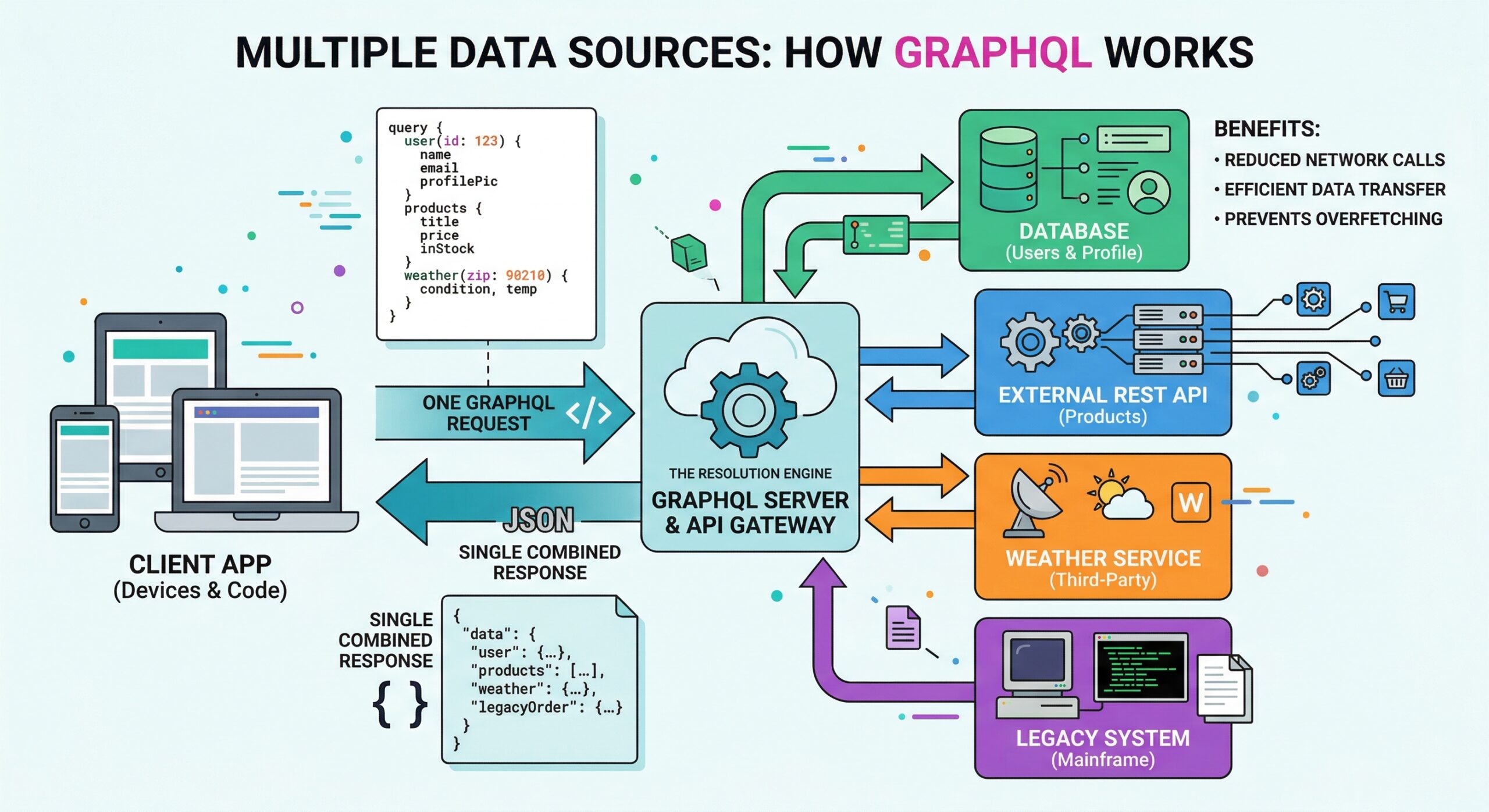
Why GraphQL for CRM
Traditional REST APIs return fixed data structures. GraphQL lets you request exactly the fields you need in a single query. For CRM data with dozens of tables and relationships, this means fewer requests and smaller payloads.
Single Endpoint
POST https://databuilder.polyxgo.com/api/v1/graphql
Content-Type: application/json
Authorization: Bearer YOUR_TOKEN
Querying Data
# List staff with specific fields
{
  staffs(limit: 10) {
    id firstname lastname email
  }
}

# Filter and sort
{
  invoices(limit: 5, sort: "-total", filter: "status:2") {
    id total status datecreated
  }
}

# Multiple resources in one request
{
  clients(limit: 5) { userid company }
  projects(limit: 5, sort: "-id") { id name }
  tasks(limit: 10, filter: "status:1") { id name }
}
Mutations: Create, Update, Delete
GraphQL mutations provide full CRUD operations with auto-generated input types:
# Create a new project
mutation {
  createProject(input: {
    name: "API Integration Project"
    clientid: 42
    start_date: "2026-05-01"
  }) {
    id name clientid
  }
}

# Update a task
mutation {
  updateTask(id: 603, input: {
    name: "Updated task name"
    status: 2
  }) {
    id name status
  }
}

# Delete a record
mutation {
  deleteExpense(id: 15) {
    success message
  }
}
Write operations require a token with write scope and per-table permissions. Security columns (passwords, tokens, salts) are automatically excluded from input types.
When to Use GraphQL vs REST
| Use Case | Best Choice | Why |
|---|---|---|
| Mobile apps | GraphQL | Minimize data transfer, single request |
| Automation (Zapier/Make) | REST | Simpler webhook payloads |
| Dashboards | GraphQL | Multi-resource queries |
| Simple CRUD | REST | Familiar HTTP methods |
| Polling sync | REST | ?since= parameter |
| WordPress integration | Either | Both work with fetch() |
For a detailed comparison, see REST vs GraphQL in Perfex CRM.
Security and Limits
- Query depth limit – prevents deeply nested queries
- Complexity scoring – blocks expensive queries
- Token scopes – control which tables and operations are accessible
- RFC 9457 errors – standardized error responses
Leave a Reply