Introduction
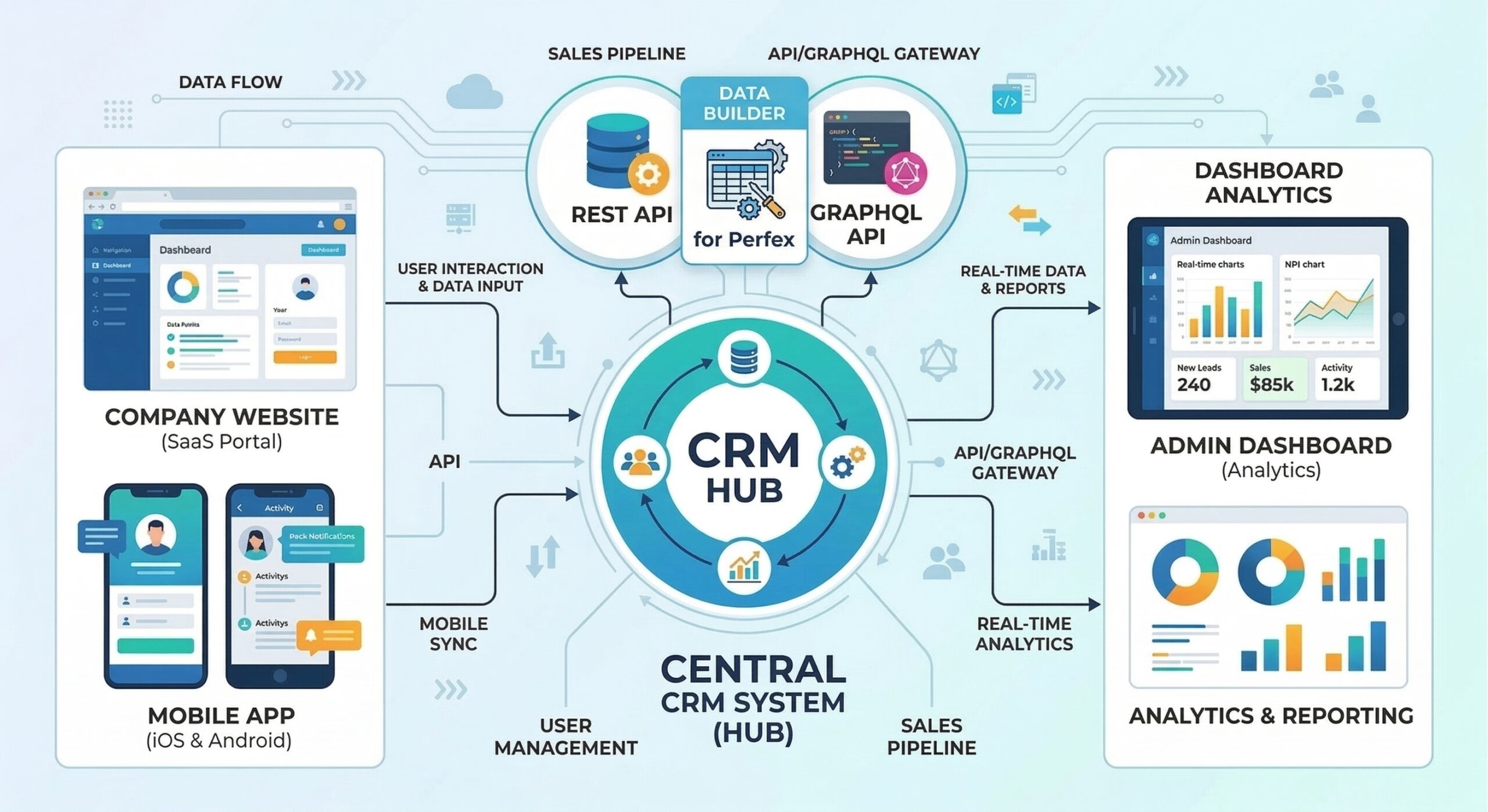
Unlock CRM data, connect external systems, and build flexible applications without direct database access. Perfex CRM API combined with GraphQL creates scalable data layer for integrations, reporting, and product development. This approach reduces complexity while enabling consistent, controlled data access across platforms.
Overview
Perfex CRM stores business-critical data across multiple modules such as clients, invoices, projects, and tasks. Accessing and using this data outside CRM often requires custom development or direct database queries, which can introduce maintenance and security challenges.
An API layer solves this by exposing structured access points. With REST API and GraphQL working together, teams can retrieve, manipulate, and integrate data efficiently while maintaining control over permissions and performance.
Instead of building custom API layers from scratch, solutions like Data Builder for Perfex CRM provide a structured way to expose CRM data through REST and GraphQL. This approach reduces development time while keeping data access consistent and secure.
REST API for Structured Integrations
REST API provides predictable endpoints for accessing CRM resources. Each endpoint represents a specific data entity, allowing systems to interact with CRM using standard HTTP methods.
This structure supports common operations such as retrieving client lists, updating invoices, or syncing project data with external systems. Filtering, sorting, and pagination help manage large datasets, making REST suitable for stable, repeatable integrations like mobile apps or third-party services.
GraphQL for Flexible Data Queries
GraphQL introduces a more flexible approach to data access. Instead of calling multiple endpoints, a single query can request exactly the required fields across multiple resources.
This reduces over-fetching and simplifies frontend development. Auto-generated schemas reflect available data structures, allowing developers to explore and build queries quickly. Query depth control helps maintain performance and prevents excessive load.
GraphQL is especially useful for dashboards, analytics tools, and applications that require combining multiple data sources into a single response.
Unified Data Layer for Reporting and Integration
Building a unified data layer manually often requires combining database queries, API development, and reporting logic.
Data Builder for Perfex CRM simplifies this process by allowing teams to create custom datasets, transform data, and instantly expose it through REST API and GraphQL.
This eliminates the need to maintain separate integration layers and ensures that reports, dashboards, and external applications all use the same structured data source.
Mobile App Integration (Android & iOS)
Mobile applications require fast and secure access to CRM data. API endpoints provide structured responses that support real-time dashboards, sales tracking, and customer management.
Instead of manually building endpoints for each use case, Data Builder enables teams to generate API-ready datasets that can be directly consumed by mobile applications.
Token-based authentication ensures secure communication, while scoped permissions limit access to necessary data only.
Website and CMS Integration
Web platforms such as WordPress or custom CMS systems can connect directly to CRM data through APIs. This allows businesses to display dynamic content such as client data, invoices, or reports on websites.
Public chart embedding enables teams to share insights externally without rebuilding reporting systems. This creates a bridge between internal CRM operations and external user-facing platforms.
Security and Access Control
Exposing CRM data requires strict control over access and usage. Token-based authentication provides a secure way to manage API access.
Additional mechanisms such as rate limiting, IP restrictions, and scoped permissions help protect data while maintaining system stability. These controls ensure that integrations remain reliable and secure across different environments.
When to Use REST vs GraphQL
REST works best for predictable operations with fixed data structures. It is ideal for integrations that rely on consistent endpoints and workflows.
GraphQL is better suited for dynamic scenarios where data requirements change frequently or multiple sources need to be combined.
Using both together allows systems to balance stability and flexibility, depending on the use case.
Final Thoughts
Perfex CRM becomes more powerful when data is accessible beyond its internal interface. A combined API and GraphQL layer enables flexible integrations, reusable datasets, and scalable application development across mobile, web, and analytics platforms.
Instead of building and maintaining multiple integration layers, using a structured solution like Data Builder for Perfex CRM helps centralize data access, simplify development, and scale integrations more efficiently.

Leave a Reply